Official hierarchy worship and bureaucratic hierarchy
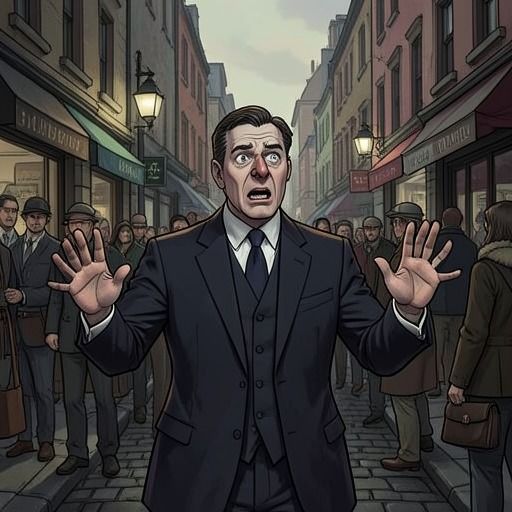
The NoseRank and bureaucratic hierarchy are the social machinery through which the absurdity of the story becomes legible: titles, uniforms, official manners, and institutional judgments determine who can claim authority and whose predicament counts. Platon Kovaloff insists on being called a Major, while his escaped nose appears as a state councillor and refuses to recognize any close relation between them. The reversal makes status more than a label: it becomes an identity that can be performed, asserted, and used to deny even the body from which it came.
Titles and the performance of rank
Kovaloff had once been a Caucasian committee-man, but he could not forget the position after leaving it. Though his committee title derived from certificates of learning, he preferred “Major,” a title he believed made him sound more important. His habit of instructing a street vendor to ask specifically for Major Kovaloff at his Sadovaia Street home shows how deliberately he stages his public identity: even a child, he boasts, could identify his residence by the title.
His ambitions give this insistence practical stakes. He has come to St Petersburg seeking a post commensurate with his rank, preferably a vice-governorship, although he would accept a bailiff’s position in a department. He is also willing to marry, but only a woman whose dowry amounts to 200,000 roubles. Rank thus organizes not only how Kovaloff names himself but what offices and marriage prospects he considers appropriate. His clean, stiff shirt collar, whiskers associated with governors, architects, and regimental doctors, and seals engraved with armorial bearings or the days of the week complete the outward signs of a man cultivating official distinction.
This self-fashioning has a comic vulnerability. When his nose disappears, the loss threatens the carefully maintained appearance through which he approaches office, social acquaintance, and marriage. Kovaloff protests that he cannot appear before ladies of high position without it; his concern is bodily, but it is also a fear that the visible sign of his standing has been removed. The story makes the nose at once an indispensable part of his face and a credential in the society where he hopes to advance.
The nose’s competing authority
The hierarchy becomes grotesquely literal when Kovaloff sees his own nose emerge from a carriage in a gold-embroidered uniform, with a stiff high collar, chamois-leather trousers, a sword, and a plumed hat signaling the rank of state councillor. The nose moves through the city as an official making calls. Its dress does not merely disguise the missing feature: it gives that feature a public identity and apparent authority superior to Kovaloff’s self-proclaimed Major’s status.
When Kovaloff addresses it, he argues that a Major cannot properly walk about without a nose and invokes the ladies he knows and the post he seeks. He expects bodily connection to settle the matter. The nose answers that it is itself and that their uniforms place them in different departments. By reading the buttons on Kovaloff’s uniform as evidence of bureaucratic jurisdiction, it converts a physical relationship into an administrative distinction. Its refusal is absurd precisely because it treats the connection between a man and his own face as less decisive than the hierarchy its costume appears to represent.
The encounter also exposes how rank depends on recognition. Kovaloff can declare that the nose belongs to him, but the nose speaks with composure and turns away; its independent official persona allows it to reject his account. Kovaloff is left trying to decide what to do, while the nose continues its calls. A body part has acquired not just mobility but a standing that makes its former owner plead for acknowledgment.
Institutions and the limits of redress
Kovaloff tries to translate the crisis into the procedures of the city. At the advertisement office, he asks for a notice promising a reward to anyone who brings the fugitive back. He initially withholds his name, explaining that he has many lady friends and does not want them to hear of the loss; the notice should identify him as a committee-man, or better, a Major. Even in seeking help, he manages the public description of his rank and the exposure of his embarrassment.
The official refuses to publish the notice because it might compromise the paper. He invokes a previous advertisement about a black-haired poodle, which had served as a satire on the cashier of an establishment, and treats the possibility of another disguised or nonsensical notice as a reason for caution. Kovaloff insists that this is not a poodle but his own nose, nearly himself, yet the official’s concern is the newspaper’s credibility rather than the exceptional nature of the loss. A procedure designed to sort public claims cannot accommodate the claim before it.
The police commissary offers no remedy. He receives Kovaloff coldly, says the afternoon is a poor time to bring a case, and remarks that respectable people do not have their noses stolen. The last remark wounds Kovaloff because he is especially sensitive to slights against his rank and social position, even when he is less troubled by insults directed at him personally. He leaves with his dignity asserted but his problem untouched. The episode shows status working as a standard of respectability that can be turned against the supposed victim: rather than investigate the impossible event, the official makes it evidence that its sufferer is not respectable.
Rank as a broken measure
The doctor’s examination carries the same mismatch between recognized expertise and the scale of the crisis. After testing the vacant place with repeated finger-flicks, he says that the nose cannot be replaced and warns that treatment could make matters worse. He recommends cold-water washing and suggests preserving the nose in spirits or warm vinegar with two spoonfuls of brandy, even offering to buy it if the price is not too high. His professional manner converts an urgent demand for restoration into a practical discussion of preservation and sale.
Kovaloff answers in the language of social consequence: he must go into good society, has invitations to two parties that evening, and knows women before whom he cannot appear in his present condition. He even offers to pay for an imperfect repair, provided the nose will hold, but neither his willingness to pay nor his rank can make the doctor restore it. The contrast is not simply between an absurd misfortune and rational authority. Each authority applies its own standards—paper reputation, public respectability, medical caution—while the consequences Kovaloff cares about remain unresolved.
That hierarchy is finally exposed as unstable rather than securely controlling the world. On 7 April, the same nose that had appeared as a state councillor is found back in its proper place between Kovaloff’s cheeks, as if nothing had happened. Its return is not explained through an official decision, a successful advertisement, or medical intervention. The social order that had given the nose’s uniform such force cannot explain its departure or restoration. Rank shapes the characters’ performances and the institutions’ responses, but it cannot master the story’s impossible event.